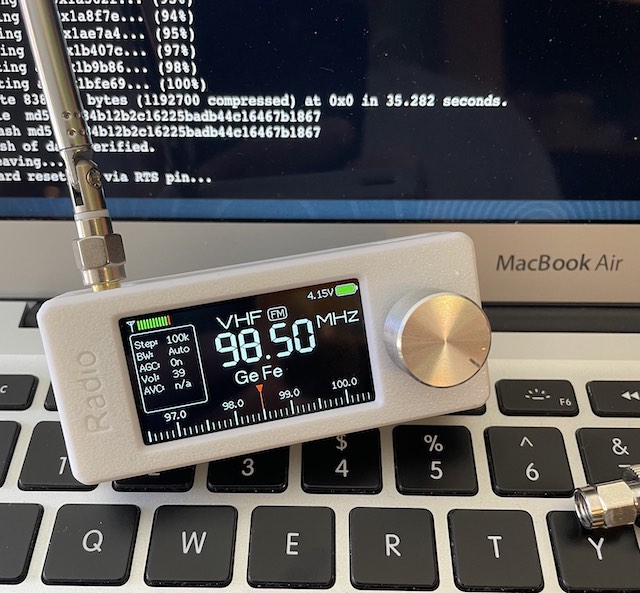
 Back in the day... as in not that long ago... radios had heft... size... often consuming their own small suitcase if you wanted to take them anywhere.
Welcome to the 21st Century with radios based on the Si4732 "chip on a radio..."
The Si4732 is a highly integrated, multi-band broadcast radio receiver chip manufactured by Skyworks Solutions (originally developed by Silicon Labs).
Utilizing an advanced digital low-IF (Intermediate Frequency) architecture, this tiny CMOS integrated circuit packs a complete radio tuner from antenna input to digital or analog audio output into a compact 16-pin SOIC package.
Out of the box, it offers exceptional digital signal processing (DSP) performance, handling FM (64–108 MHz), Longwave (153–279 kHz), Mediumwave/AM(520–1710 kHz), and Shortwave (2.3–26.1 MHz) bands while integrating modern features like RDS/RBDS data decoding.
Because it handles tasks like Automatic Gain Control (AGC), Automatic Frequency Control (AFC), and programmable channel bandwidth filters entirely on-chip, it dramatically reduces the component count and cost required to build a radio. Which is to say, I could build a radio... you could build a radio... let's all build radios (channelling Al Pacino...)
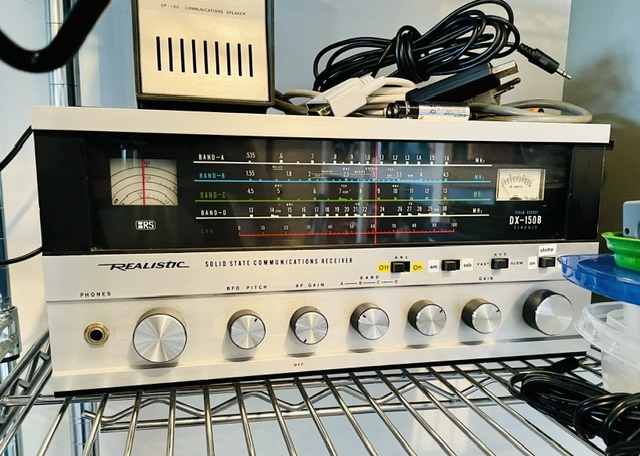 Photo right - my first important receiver I ever had - the DX150B purchased on November 3rd, 1973... it was a Saturday... an eventful Saturday!
In recent years, the Si4732 has achieved massive popularity within the open-source hardware, DIY electronics, and portable amateur radio communities.
This is largely due to an innovative community-developed "hack" involving a microcode patch that can be uploaded via I²C from microcontrollers like the ESP32 or Arduino.
This microcode extension unlocks Single Sideband (SSB) demodulation—including Upper Sideband (USB) and Lower Sideband (LSB)—allowing ultra-compact, inexpensive pocket receivers to listen to amateur radio operators, Morse code (CW), and emergency communications.
Consequently, the chip serves as the core engine behind countless commercial mini pocket radios, 3D-printed hobby projects, and emergency radio kits globally.
So what about mine? OK. It is smaller than you think. At scarcely 3 and 1/4" inches wide, it does virtually everything my larger (and much older) tabletop brother and sister radios can do -- with some exceptions...
Let's talk about the form and functions... Everything comes down to a single knob and a fairly navigable menu -- oddly easy to read with my well beyond middle age eyes. The display is barely 2" diagonally... but I can see it. The single knob is either turned or pushed. That is it. Modes like band, filter, audio, AGC, mode, deeper settings, memories (apparently) are controlled and/or selected in menus... and yea, the menus are pretty darn intuitive.
My only beef is: The encoder or firmware on mine is ever so glitchy that when entering "mode" with a knob push, the menu selections can skip about a bit -- mine has been like this since day one. It could come down to a little flush of "DeOxit" tech in a can... if the encoder has any kind of access. Not too worried about it.
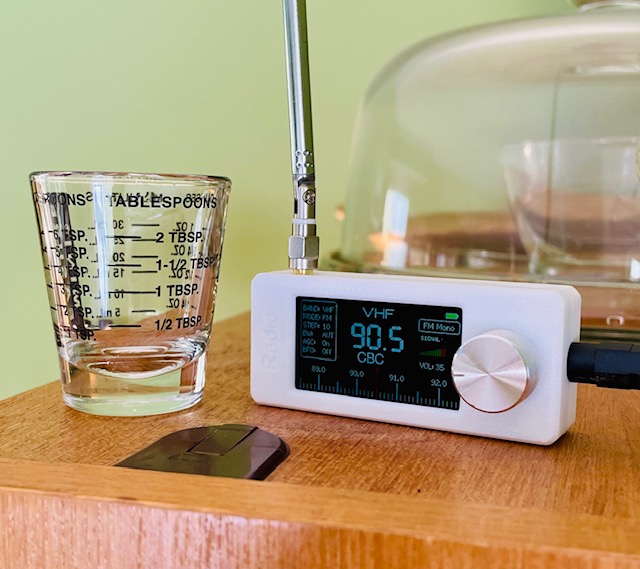 So we move on... Audio: OK, here are the straight goods. The audio from this gem (by itself) is not going to cut it. I have the 1/8th" stereo out plugged into some fancy Yamaha computer satellite speakers and a sub-woofer. That alone brings this radio into "the bigs..." A radio is only as good as its audio - and some powered augmentation is a must. Don't waste time or money on headphones. There is barely line level out so find a BT speaker that has 1/8" or RCA in and get a suitable cable. You will thank me later. So once you have a suitable amplified speaker, it is time to dive in.
I have a variety of antennas and some very practical multi-port distribution amps. You know, an antenna input that buffers, balances and isolates four antenna outputs... that means, one antenna can handily feed four radios at the same time. That is a priceless feature for any shack and mine is no exception. I never have only one radio on at a time... an exception includes when I have my Kenwood 100 watt HF transceiver on... then and generally only then, the active outdoor antennas are off leaving my 80-10 meter end-fed-long-wire ready to transmit.
I digress. Side by side, my two Drake receivers (the R8 and the R8B), a JRC NRD525 are usually purring when I am testing out other gear (like active antennas or antenna termination controllers...) which means the "little radio" can be swiftly compared to the "Big Bench Radios..." And the comparisons are generally pretty pleasing I must say. Signal to signal, if it is audible on one of the premium Drake radios, I can hear it on the Si4732 mini radio. That is impressive. And dollar for dollar, well, what can I say. With a few extra bits and pieces one can jump into the realm of World band radio for around $100. That is staggering.
So, do I have any beefs or wants? Selectable synchronous detection (between upper and lower sidebands...) and passband tuning would be dreamy... but this is a 1 knob 99$ radio... so let's stay real.
Signal handling: My listening area is moderately hot with AM and FM signals and the unit handles all of this with aplomb. No weird signals showing up where they shoudn't, glitches, pops or surprises. I see no reason why every radio listener, DXer, SWL, signal chaser does not have at least one in their kit. Get out there. Buy one. Send me any questions via the emails.
Colin Newell is a Victoria B.C. Canada radio enthusiast, DXer, SWL and licensed ham radio guy as well as a red seal electronics engineering technologist now retired after 36 years working in the biz at the local University. He has been writing stuff like this since the early 1990's. Drop him a line with your thoughts.